Three Korean brokers published on RF Materials (KOSDAQ: 327260) inside seven weeks. All three describe the same business: a small hermetic-package maker that sits inside Lumentum’s pump laser supply chain, carried along by the datacentre interconnect build-out. The stock is up roughly tenfold in twelve months. We read the three against each other, and against a rights offering none of them put in the summary.
Last verified: 15 September 2026. Built from Shinhan Investment Securities (10 September), Shinyoung Securities (27 August) and Hana Securities (28 July), from the company’s May rights-offering filing as reported by Bloter, and from the US Department of War’s Section 1260H list update of 8 June 2026. Lumentum’s own remarks are quoted as the Korean brokers summarised them; we have not read the earnings transcripts directly, and say so rather than imply otherwise.
What the company actually makes
RF Materials makes hermetic packages for compound semiconductors. RFHIC took a stake in 2017 and the company listed on KOSDAQ in 2019. It supplies GaN packages to its parent RFHIC, and pump laser packages to Lumentum. Communications packages were about 84 per cent of 2025 standalone revenue, on Shinyoung’s figures.
A pump laser package is not a shell. The laser runs hot, and the package has to move that heat out, seal the chip against moisture and dust, and hold the chip, the fibre and the temperature-control parts in fixed alignment. Shinyoung’s framing is that the package determines output stability and service life rather than merely housing the part. That is the argument for why a packaging specialist earns a margin here at all.
Shinhan puts the Lumentum-bound revenue at roughly KRW 3–4bn in 2024, KRW 12bn in 2025, KRW 30bn in 2026 and above KRW 70bn in 2027. It describes the company as effectively the only Korean name inside Lumentum’s value chain.
The reported numbers, and where the estimates begin
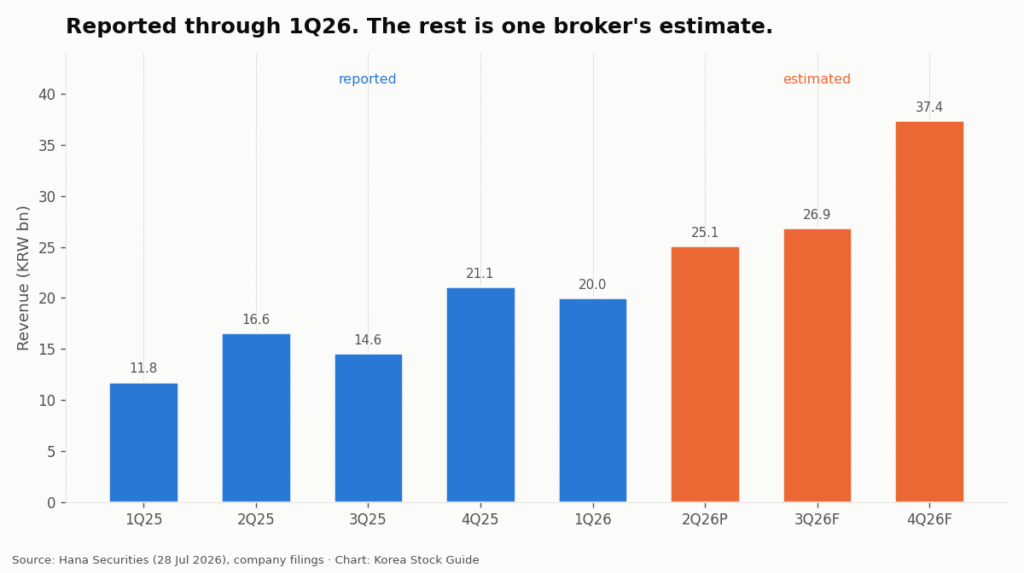
Hana reports second-quarter 2026 consolidated revenue of KRW 25.1bn, up 51 per cent year on year, with operating profit of KRW 5.3bn, up 182 per cent. Stripping out the RF Systems subsidiary, standalone revenue was KRW 13.5bn and standalone operating profit KRW 3.6bn — the latter against a very small base a year earlier.
Operating margin is the number that has moved. It was 7.1 per cent in the first quarter of 2025. Hana has it at 21.1 per cent in the second quarter of 2026.
Where the three brokers agree
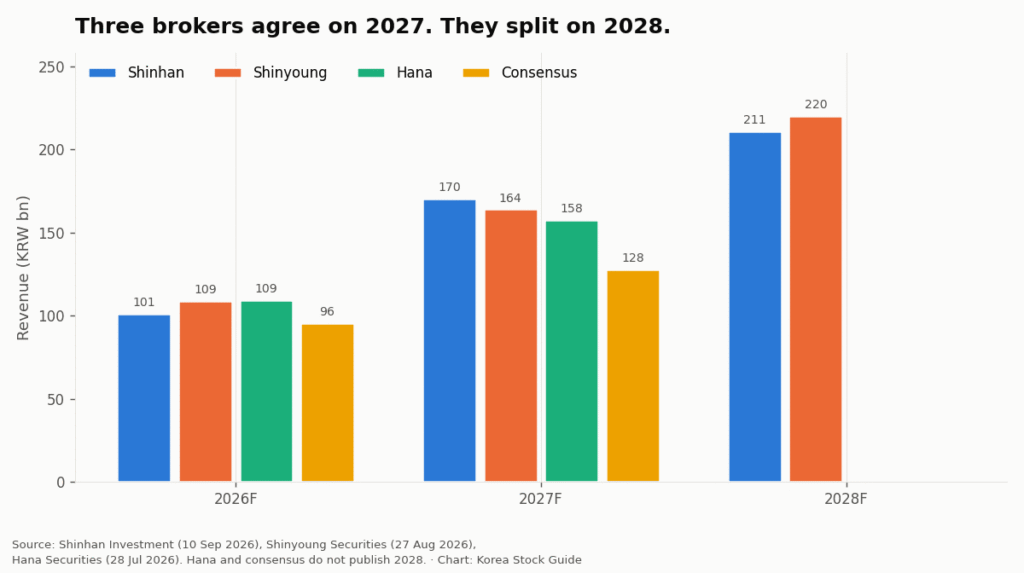
For 2026 they land within eight per cent of each other: KRW 101.2bn (Shinhan), KRW 109.0bn (Shinyoung), KRW 109.3bn (Hana). For 2027 the spread is KRW 158bn to KRW 170bn. All three sit above the KRW 95.5bn 2026 consensus that Hana prints in its own report, which is worth noting: the houses covering this name are more positive than the average estimate on the tape.
Where they split
2028 is where the agreement ends. Shinhan models KRW 210.9bn of revenue and KRW 42.5bn of operating profit. Shinyoung models KRW 220bn and KRW 52bn. Hana does not publish a 2028 line at all. A KRW 9.5bn gap on operating profit two years out is not a rounding difference; it is a different view of how much of the capacity expansion converts.
The ratings diverge further than the numbers do. Hana has a Buy with a KRW 75,000 target, halved from KRW 150,000 to reflect the one-for-one bonus issue listed on 18 August. Shinyoung calls the stock its top pick in optical communications with a KRW 68,000 target, derived from a 30 times multiple on 2028 earnings. Shinhan declines to rate it at all — no target, no recommendation — while writing the most enthusiastic prose of the three. Those are their numbers and their calls, not ours.
The bull case
Shinhan’s description of RF Materials is that it is effectively the only Korean company inside Lumentum’s value chain for this part, and the customer is the reason that matters. Lumentum holds 70 to 80 per cent of the pump laser market on Shinhan’s figures, has guided to roughly quadrupling output over several quarters, and is contracting mostly on three-year take-or-pay terms. That is a supplier telling the market it is sold out and buying ahead of itself.
What sits underneath the demand is newer than the pump laser business. Linking datacentres tens to hundreds of kilometres apart requires optical amplification along the route, and that requirement does not wait for new datacentre construction to finish. It attaches to buildings that already exist, which is a different demand curve from the one most AI hardware suppliers are riding.
There is also a second product already moving. Shinyoung reports that ELSFP packages for co-packaged optics are going to Lumentum now, with volume production expected from 2027, and frames that as inclusion in the Nvidia CPO chain rather than a separate venture. Meanwhile a competitor lost ground by administrative action rather than commercial failure: Zhongji Innolight was added to the Section 1260H list of Chinese military companies published on 8 June 2026, which Hana reads as accelerating the displacement of Chinese components.
The bear case
None of that makes the shares cheap on any number that has been reported. The 2026 price-to-earnings multiple runs 46 to 59 times across the three houses. The stock only looks reasonable on 2027 and 2028 estimates — which is to say on the part nobody has published results for yet.
Concentration is the second problem. The thesis is one account’s ramp, and Shinhan’s own risk line concedes that US optical sentiment will move the share price regardless of what the company itself does. You are buying a Korean supplier and taking an American sentiment exposure.
Nor are you early. Twelve-month return was 832 per cent as of Shinhan’s note on 10 September and 1,104 per cent as of Shinyoung’s on 27 August. The 52-week low sits somewhere between KRW 2,811 and KRW 4,538 depending on which report you open. Shinhan wrote its note the day after a 23 per cent single-session move.
And two of the load-bearing facts are dated later than the enthusiasm around them. The new Ansan plant, the one that doubles output, is targeted for completion in the fourth quarter of 2027, so the 2027 forecasts rest on the existing plant plus the move to two-shift production in November rather than on the new building. The expanded Section 1260H supply-chain prohibitions take effect on 30 June 2027, which makes Chinese displacement an expectation rather than a mechanism already running.
The financing that did not make the summaries
In May the company approved a KRW 28.2bn rights offering: 500,000 new shares at KRW 56,300, a 20 per cent discount to the reference price, with the final price fixed on 15 June and existing-holder subscription on 18–19 June. Proceeds were allocated KRW 8.8bn to land in Ansan, KRW 16.2bn to the new plant and KRW 3.2bn to raw materials. RFHIC took its full allocation of roughly 207,708 shares.
None of the three reports we read carried this in the summary section. It matters twice over. The parent funding its entire entitlement is a confidence signal worth having. And the capital expenditure behind the 2028 case is being paid for by shareholders, on a plant that completes at the end of 2027.
What would break this
The case fails in recognisable ways. Lumentum’s pump laser commentary reverses, or its capacity plan slips. A second packager is qualified and the sole-supplier position goes with it. The Ansan plant runs past the fourth quarter of 2027 and pushes the step-up out of 2028 entirely. Chinese displacement does not arrive despite the designation. Or the 2028 estimates converge downward toward Hana’s implied path rather than upward toward Shinyoung’s, which would take the valuation argument down with them.
The dates to watch
Third-quarter results arrive in late October. Hana models KRW 26.9bn of revenue at an 18.0 per cent operating margin, and Shinhan expects operating profit to climb through the year, with the second quarter below the third and the third below the fourth. November brings the move to two-shift production, which is the near-term capacity lever rather than the new plant. After that the calendar thins out: 30 June 2027 for the Section 1260H supply-chain prohibitions, and the fourth quarter of 2027 for completion of the Ansan plant.
Editor’s opinion
The evidence is better than the price
Where this looks bad to us. The shares are priced on 2028. At 46 to 59 times this year’s earnings you are paying today for a plant scheduled to finish at the end of 2027, funded by a rights issue that closed in June. Anything that moves that completion date moves the whole case — and the two houses that do publish 2028 already disagree by a quarter on operating profit. Put a single customer and a single product behind that, and the range of outcomes is wider than two target prices ten per cent apart would suggest.
Where it looks better than most. The demand evidence is unusually well documented for a KOSDAQ company this size. The customer is named. Its commentary is public and repeated across four consecutive quarters. The contracts are described as three-year take-or-pay. A second product is already shipping rather than promised. Most Korean small caps at this multiple ask you to trust a pipeline; this one points at someone else’s earnings call, which you can go and read.
And the capital is committed rather than announced. RFHIC took its full entitlement in the June rights issue. The land in Ansan is bought, not budgeted. That does not guarantee the plant lands on schedule, but it moves the 2028 case from a slide into a construction contract. On this site we spend a lot of time separating what a Korean company has committed from what it has announced, and this one falls on the committed side.
So where does that leave a foreign investor? Our view is that the business case is better evidenced than the price is, which makes this a sizing question rather than a thesis question. If you want the exposure, 2027 gives you three quarters of checkpoints before the new plant matters at all. If you need that plant to work for the position to work, you are underwriting a construction schedule — and that is a different investment from the one these three reports describe.
Sources
Three broker reports underpin this piece: Shinhan Investment Securities on 10 September 2026 (analyst Kim A-ram, Not Rated), Shinyoung Securities on 27 August 2026 (target KRW 68,000) and Hana Securities on 28 July 2026 (analyst Kim Hong-sik, Buy, target KRW 75,000). The rights offering terms come from Bloter’s May 2026 report of the company’s regulatory filing, and the Section 1260H designation from the US Department of War’s list update of 8 June 2026, as summarised by Holland & Knight.
Share price and market capitalisation figures are as printed in each report on its own date and have not been updated to the time of writing. Broker estimates are reproduced in summary; the reports themselves are licensed distributions and are not reproduced here.