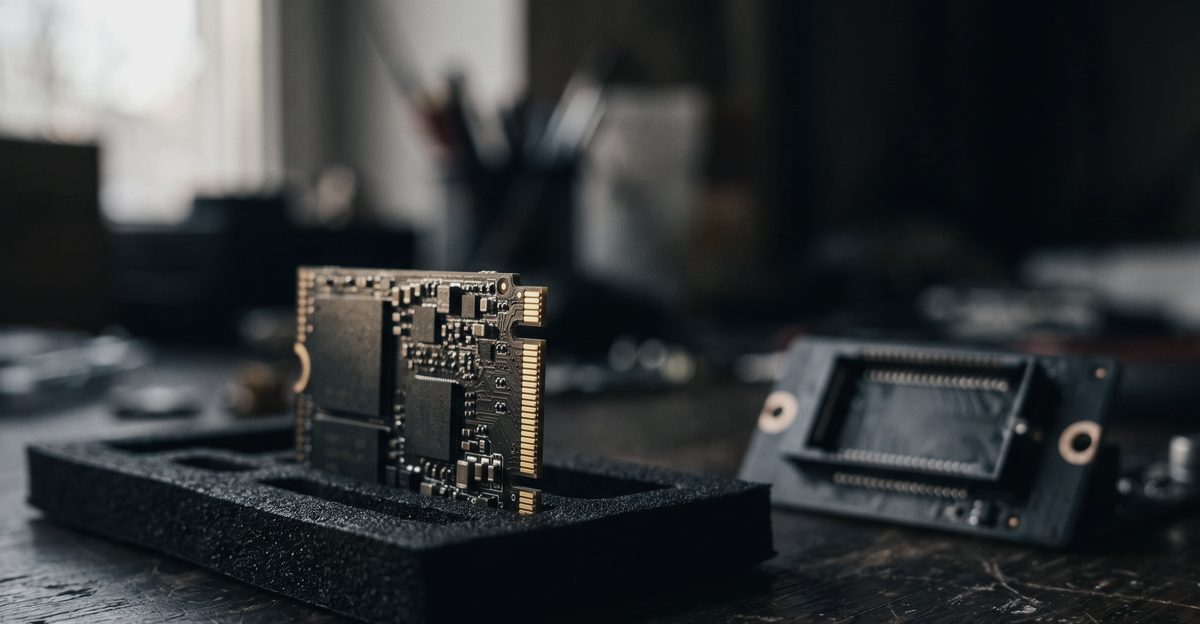
Three Korean brokerages published on TLB (KOSDAQ 356860) in August and September, and all three tell the same story: SOCAMM, the detachable memory module Nvidia’s Vera CPU uses, is about to carry the company’s margins. None of the three mentions that in late July Nvidia was reported to have halved the memory capacity of that module. Put the two together and the reassuring answer falls out of the arithmetic rather than out of anyone’s forecast: the cut takes gigabytes out of the memory makers’ order book, and leaves the substrate count alone.
Last verified: 17 September 2026. Built from three broker reports supplied to us — Meritz Securities, IBK Investment & Securities and Yuanta Securities Korea — together with TrendForce’s public reporting of 28 July 2026 and Nvidia’s own published Vera specifications. The broker figures are estimates and the target prices are as at mid and late August, so the share price has moved since. The module arithmetic below is derived from published capacity figures and is checkable; we show the working.
Editor’s opinion
A substrate maker is paid per module, not per gigabyte
Our view is that the memory cost problem inside Vera Rubin is a serious one for Samsung Electronics, SK hynix and Micron, and close to irrelevant for the company that makes the board the memory sits on. That is not optimism. It is what the published numbers say when you divide them.
What we would watch instead is the module count per processor, which is the only variable in this chain that TLB is actually exposed to. Nobody has reported a change to it, and the moment somebody does, everything in the bull case moves at once. The second thing we would watch is the form factor itself: a customer willing to halve density to defend a bill of materials is a customer thinking about the socket as well as the chips.
We take no view on the share price, and we note that the two houses that published targets are 37,000 won apart on a stock that has traded between 12,230 and 62,888 won over a year. That spread is the honest summary of how early this is.
Andrew Lee. This section argues a view rather than establishing a fact. It is not a forecast and not a recommendation, and the material it draws on is listed in the sources below.
What SOCAMM is, and why Vera needs it
Nvidia’s Vera is an 88-core, 176-thread processor built for agentic workloads, and it carries up to 1.5 terabytes of LPDDR5X reached over SOCAMM2 at 1.2 terabytes per second. The format exists because soldered memory cannot be serviced and registered server memory cannot deliver that bandwidth per watt. IBK’s note puts the comparison at roughly twice the bandwidth of an RDIMM with a 75 per cent improvement in energy efficiency.
TLB does not make memory. It makes the printed circuit substrate the module is built on, and it sells one substrate per module regardless of how many gigabytes of DRAM the memory maker mounts on it. That distinction is the entire subject of this article, and it is the one the three reports skip past.
The capacity cut, and what it actually cut
On 28 July 2026 TrendForce reported that Nvidia had cut SOCAMM capacity in its Vera Rubin NVL72 racks from 192 gigabytes to 96, taking total Vera processor memory in a rack from about 55 terabytes to about 28. The reason given was cost. Memory was running at around 29 per cent of the estimated 2.1 million dollar bill of materials for a VR200 system, against a threshold Nvidia prefers to keep near 20 per cent, and GF Securities is cited putting the LPDDR5X content at about 586,000 dollars after the change against 1.2 million before it. Supply was the other half of it: TrendForce had reported in June that preliminary allocation plans from Samsung, SK hynix and Micron together would cover only about 60 per cent of Nvidia’s estimated demand for this class of memory.
Read quickly, that sounds like a halving of the SOCAMM opportunity. It is not, and the published numbers settle it without needing anybody’s estimate. IBK’s note states the configuration directly: 192 gigabytes per module, eight modules per Vera processor. Nvidia’s own specification says up to 1.5 terabytes per processor, which is what eight 192-gigabyte modules come to. An NVL72 rack holds thirty-six Vera processors.
Where the halving lands
Vera Rubin NVL72 memory arithmetic, from published module and rack figures
| Line | Before | After |
|---|---|---|
| Capacity per module | 192 GB | 96 GB |
| Modules per processor | 8 | 8 |
| Memory per processor | 1.5 TB | 768 GB |
| Processors per rack | 36 | 36 |
| Memory per rack | 55 TB | 28 TB |
| Substrates per rack | 288 | 288 |
The reported rack totals of roughly 55 and 28 terabytes are what eight modules per processor and thirty-six processors per rack produce at 192 and 96 gigabytes. Module count is the line that does not move, and module count is the line TLB invoices against. What halves is bits, which is Samsung’s, SK hynix’s and Micron’s revenue, not the substrate maker’s.
We should be careful about how far that goes. The 192-to-96 figure is TrendForce reporting a plan, not a specification Nvidia has published, and the eight-module configuration comes from a broker note rather than from Nvidia. The arithmetic is consistent across three independent numbers, which is why we think it holds, but a reader who wants a document rather than a reconciliation does not have one here.
What the three houses actually say
The reports agree on direction and differ sharply on magnitude, which is worth showing rather than averaging away. Yuanta’s mid-August note is a road-show write-up: it puts quarterly SOCAMM revenue at 3 billion won in the first quarter, about 10 billion in the second and 50 billion across the second half, and tracks the capacity that has to arrive for that to happen, with the second Ansan plant and the Vietnam line phasing in from the second quarter and a further step when the second Vietnam plant completes in 2028.
IBK initiated coverage in late August and supplies most of the structural detail this article leans on: the eight-module configuration, a SOCAMM substrate priced at roughly three times a standard server memory substrate, a second-quarter order backlog up from 36.2 billion won to 131.8 billion, and a field of about five qualified suppliers worldwide of which TLB is one, at roughly a fifth of it. Meritz published a quarterly preview in September, trimming its revenue estimate on a stronger won while raising its profit estimate on mix, and is the only one of the three to flag MR-DIMM as the next format.
Three houses on the same company
TLB (KOSDAQ 356860), broker reports of August and September 2026
| House | Published | Call | Target | Price then |
|---|---|---|---|---|
| Yuanta | 18 Aug | Buy, raised | 90,000 | 31,400 |
| IBK | 26 Aug | Buy, initiation | 53,000 | 38,700 |
| Meritz | September | Preview | — | — |
Won per share, as at each report’s own date; the share price has moved since, and the twelve-month range is 12,230 to 62,888 won. On the company’s own guidance both Yuanta and IBK report the same sequence: a 2026 SOCAMM revenue target raised three times, from 20bn won at the start of the year to around 70bn, with roughly 150bn indicated for 2027. The two houses put the substrate price premium at about three times a standard server substrate and about twice a conventional BVH part respectively. Those are different baselines, not a contradiction, and neither is a disclosed figure.
The exposure that is real
If the density cut is not the risk, something else is. Three things are.
The first is module count per processor. It is the one number in this chain that maps one-to-one onto TLB’s unit volume, and a customer that has already shown it will trade capacity for bill-of-materials discipline is a customer that could come back for the socket count. Nobody has reported a change. If somebody does, the density arithmetic above stops being reassuring immediately.
The second is concentration. Around five companies worldwide are qualified to supply this substrate and TLB is one of them, which is the reason the margin is what it is. It is also the reason a single customer’s design decision propagates straight to the income statement. The company’s own guidance has been raised three times in a year on one product line, and a number that moves that fast upward has the range to move the other way.
The third is the next format, which Meritz raises and the other two do not. MR-DIMM puts multiple DRAM ranks in parallel to widen bandwidth within the existing DIMM form factor, so it slots into current server designs in a way SOCAMM does not, and its substrate is harder to build: sixteen layers, two BVH boards manufactured separately and then laminated together. Meritz reads that as a second leg of pricing power. It can equally be read as the format that arrives if SOCAMM does not spread beyond Nvidia, since one of them exists precisely because the other requires a new socket. Adoption is at the discussion stage with North American cloud operators and processor vendors, which is to say it is not yet an order.
What would settle it
The third-quarter result is the first checkable test. Meritz expects 96.7 billion won of revenue and 17.0 billion of operating profit, against a second quarter of 88.2 billion in revenue. Guidance implies SOCAMM revenue stepping from roughly 10 billion won in the second quarter to about 50 billion across the second half, so the third-quarter SOCAMM number is the one that either supports that curve or does not.
Beyond that, the disclosure worth waiting for is a customer list. Yuanta reports the company expects to be qualified at all three global memory makers; at present the reporting supports a concentrated position. A supply agreement disclosure, if one is ever large enough to require filing, would convert the guidance into something a reader can audit. Until then this is a company whose 2027 case rests on one format, one processor family and one customer’s bill of materials, and the honest version of the bull case has to say so.
The reason to spend time on a substrate maker at all — and TLB is not the only Korean one, as the packager sitting inside Lumentum’s pump lasers shows — is that it is one of the few places where the memory shortage shows up as somebody’s pricing power rather than somebody’s cost. The same squeeze that made Nvidia halve a module’s density is what pushed the module out of the memory maker’s hands and onto a detachable board in the first place.
Sources
We take facts from these and write our own sentences. Where a figure originates in a broker estimate we name the house. Broker reports supplied to us privately are identified by house, analyst where shown, and date; we do not reproduce their tables, models or target-price rationales.
Public documents and reporting
- TrendForce, “NVIDIA Reportedly Halves Vera Rubin SOCAMM Capacity as Memory Costs Near 29% of System BOM”, 28 July 2026. Source for the 192 to 96 gigabyte change, the 55 and 28 terabyte rack totals, the 29 per cent share of a 2.1 million dollar bill of materials, the GF Securities cost figures and the June allocation estimate of about 60 per cent of demand.
- Nvidia, Vera CPU product page, and Hot Chips 2026 disclosures as reported by Tom’s Hardware. Source for 88 cores, 176 threads, up to 1.5 terabytes of LPDDR5X and 1.2 terabytes per second over SOCAMM2.
Broker reports supplied to us
- Meritz Securities, TLB company brief, analyst Yang Seung-soo, September 2026. Source for the third-quarter estimates, the direction of the revenue and profit revisions and the foreign-exchange assumption behind them, and for the MR-DIMM description including the sixteen-layer construction.
- IBK Investment & Securities, TLB initiation, late August 2026, price as at 25 August. Source for the eight modules per Vera processor and 192 gigabytes per module configuration, the bandwidth and energy comparison against RDIMM, the substrate price premium, the second-quarter order backlog and the count of qualified suppliers.
- Yuanta Securities Korea, TLB road-show note, mid-August 2026, price as at 14 August. Source for the quarterly SOCAMM revenue path, the guidance revisions, the capacity timeline at Ansan and in Vietnam, the second-quarter revenue figure and the twelve-month share price range.
Material we could not open
- Nvidia has published no specification confirming the module count per Vera processor or the revised per-module capacity. Both figures in our arithmetic come from a broker note and from TrendForce reporting respectively, and we reconcile them against Nvidia’s published per-processor total rather than against a document that states them.
- TLB has disclosed no customer, no supply agreement and no SOCAMM revenue figure of its own. Every SOCAMM number in this article is company guidance relayed through a broker.
Corrections
None yet. If you can point to a primary document that contradicts anything above, we will correct it and say what changed.
Disclosure. The author holds no position in any company named in this article as of the date of publication. This article is general information and analysis about a component supply chain. It is not investment advice, not a recommendation to buy or sell any security, and not a forecast of any price or index level. Broker target prices are reported as facts about what those houses published on the dates shown; they are not our estimates and we do not adopt them. The section headed Editor’s opinion is comment: it argues a view, and we fence it off from the sourced material for that reason. We have not tailored anything here to your circumstances, and only a qualified adviser in your jurisdiction can do that. We are not registered as an investment adviser in any jurisdiction, and this site has no commercial relationship with any company, exchange or research provider named above. See the Editorial & Sourcing Policy and Disclaimer.